Flight Wifi Test: 35,000 feet up in sky, yet I feel like being on ground

In-flight Wi-Fi has transformed air travel, making it possible to stay connected even at 35,000 feet. But what makes this connectivity work?
Behind the scenes, a sophisticated system works tirelessly from take-off to landing, allowing you to check emails, stream movies and chat with ease.
So, we asked ourselves: Is it reliable? Is it worth the extra cost for onboard WIFI? Is it delivering value for both passengers and airlines? To answer these questions, we conducted unbiased detailed study on Delta Airlines with Wi-Fi in American Airspace, covering over more than 4000kms of flight time.
Where is in-flight connectivity taking us in the future? Our latest analysis of Delta Airlines' Wi-Fi shows how connectivity is changing the way we experience air travel at 35,000 feet.
WHY IN-FLIGHT CONNECTIVITY MATTERS
The in-flight entertainment and connectivity market is projected to expand from $8.6 billion in 2024 to $11.7 billion by 2029, fuelled by rising demand for seamless connectivity, advancements in technology, and intensifying competition among airlines.
These days, passengers expect seamless access to work, entertainment, and communication, no matter where they are. For airlines, it's a win-win—boosting customer satisfaction while offering premium connectivity options that bring in additional revenue.
KEY INSIGHTS FROM OUR DELTA AIRLINES STUDY
Flight Path Covered:
Data was gathered from two major Delta Airlines routes, covering over 2,800 miles (4,510 kilometres). Measurements were conducted with over 1,000+ samples per metric.
| Metric | Findings | Impact on Passengers |
|---|---|---|
| Download Speed | 18.61 Mbps (average for over 2661 samples); Peaks up to 63.49 Mbps | You can easily watch videos, go on websites, WhatsApp, Teams chat, and check your emails without problems. |
| Upload Speed | 2.17 Mbps (average for over 3128 samples); peaks Up to 7.11 Mbps | It’s good for sending photos, videos, and emails, Teams messaging quickly. You can get things done. |
| Latency | Average RTT 1019.01 Mbps, with highest latency of 11587ms with 4117 samples | It’s okay for sharing photos and posting on social media. You can stay connected with your family. |
| Streaming Quality | Average DL data rate is 0.4Mbps, lowest launch time is 11.81s for 1927 samples | Able to use YouTube, Netflix, Prime etc play smoothly. |
| Web Performance | Amazon - 6, Google - 14, CNN - 14, Facebook - 15 | Facebook is fun, Google works well, and you can watch the news easily. Web browsing might be slow due to high latency. |
Testing Methodology
We used RantCell Pro on a standard Android device to simulate real passenger experiences, zeroing in on speed, latency, and reliability to get an accurate picture of in-flight connectivity.
BENEFITS OF IN-FLIGHT CONNECTIVITY
For Passengers:
-
Stay connected for work, entertainment, and communication.
-
Share travel moments in real-time or access important info.
For Airlines:
-
Build customer loyalty with improved services.
-
Generate revenue through premium connectivity options and ads.
For Telecom & Satellite Providers:
-
Expand reach with creative partnerships.
-
Drive revenue through customized in-flight packages.
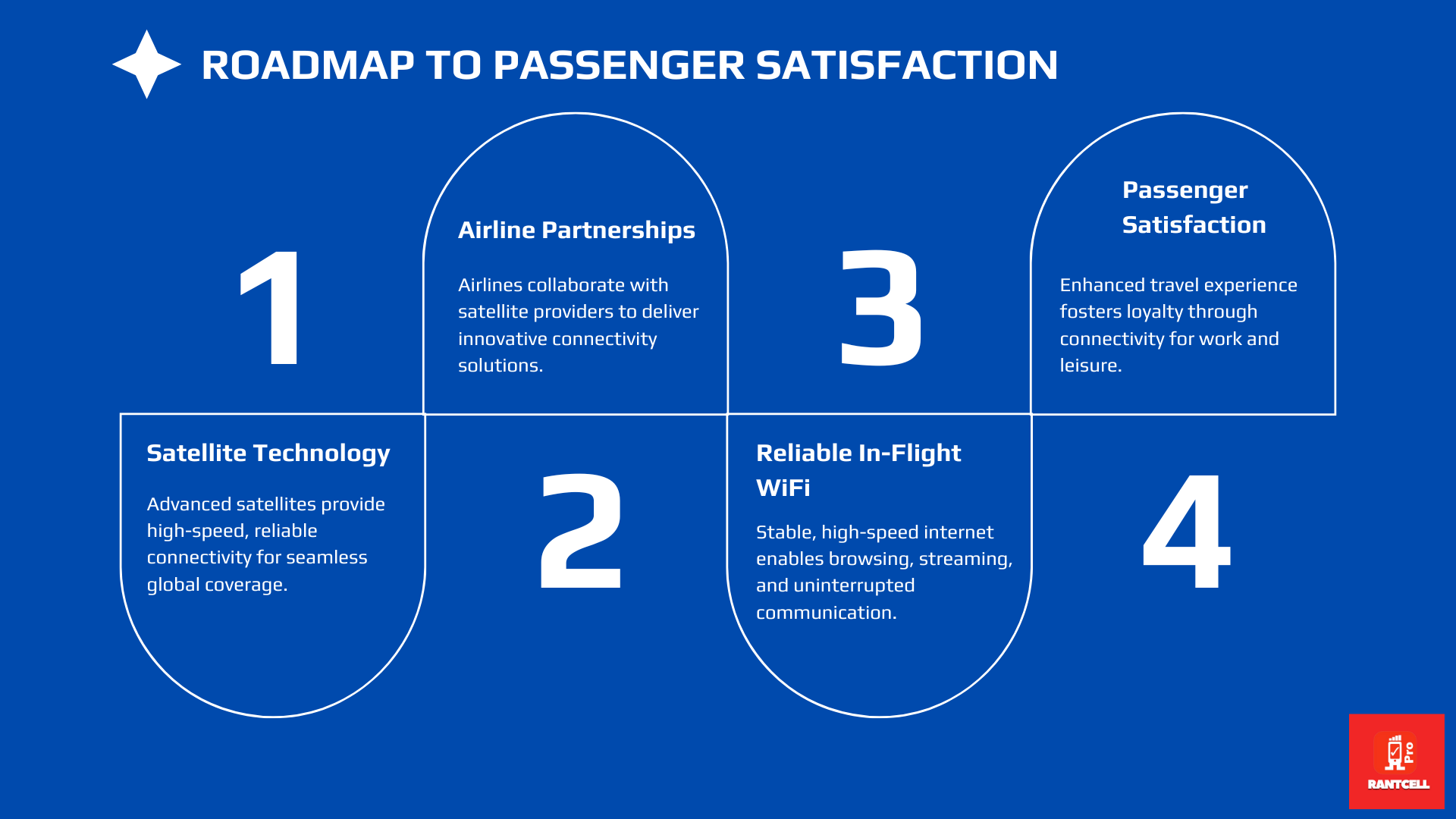
Connectivity Flowchart
Addressing Challenges
While in-flight connectivity has improved significantly, there are still some challenges:
-
Latency Spikes:With an average latency of 790ms, real-time applications like gaming or HD video calls can experience noticeable delays, making them less suitable for these activities.
-
Limited HD Streaming:Although SD streaming on platforms like Netflix and Prime works well, HD content can face occasional buffering due to slower speeds and the occasional latency spike.
-
E-Commerce Challenges: Web performance for shopping sites like Amazon shows a 50% success rate, meaning passengers may encounter difficulties when browsing or purchasing items online.
CONCLUSION
Is it really reliable?
Yes, the connectivity is generally reliable for everyday activities like browsing, streaming, and checking emails. The Wi-Fi on Delta Airlines allows passengers to browse social media, stream SD content, and handle productivity tasks.
Is it worth the extra cost?
For passengers who want to stay connected for productivity, entertainment, and communication, the extra cost can be worthwhile. SD streaming on platforms like Netflix and Prime works smoothly, and passengers can enjoy a hassle-free experience for web browsing and social media.
Is it delivering value for both passengers and airlines?
Yes, passengers get the benefit of staying connected during their flight, which enhances their overall experience. Airlines can improve customer satisfaction and generate extra revenue by offering premium connectivity options. Telecom and satellite providers can also capitalize on new opportunities by offering customized, premium packages to passengers.