Holi Swindon 2026: How Mobile Networks Performed Under High User Density
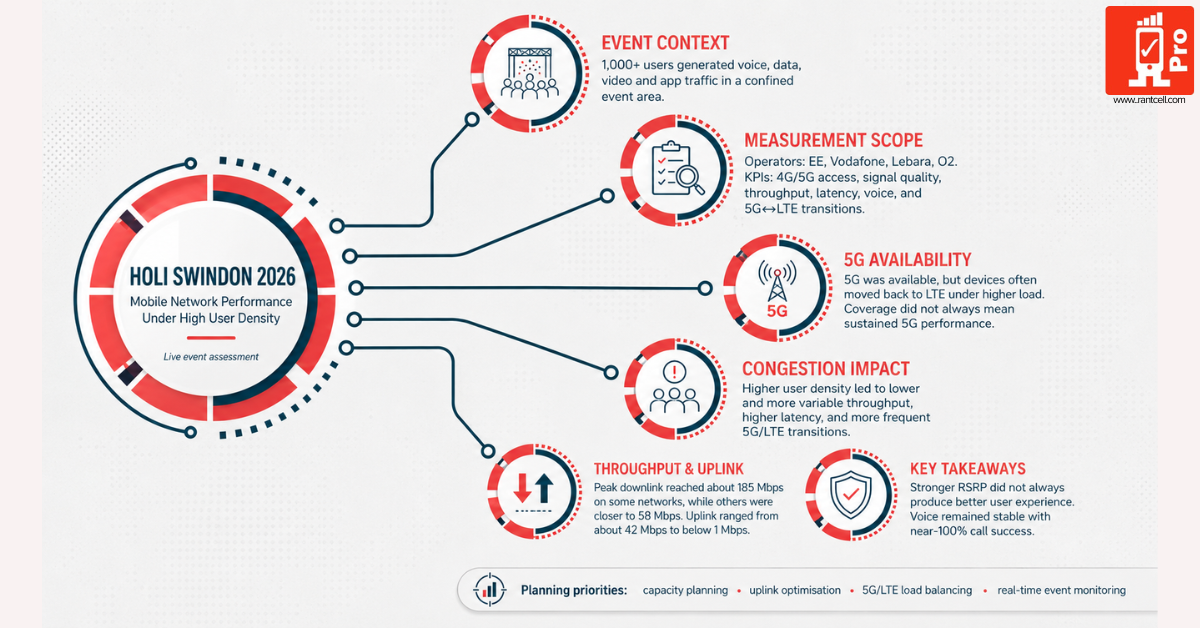
Holi Swindon 2026 created a concentrated mobile-demand environment, with more than 1,000 users generating voice, data, video and application traffic within a limited area.
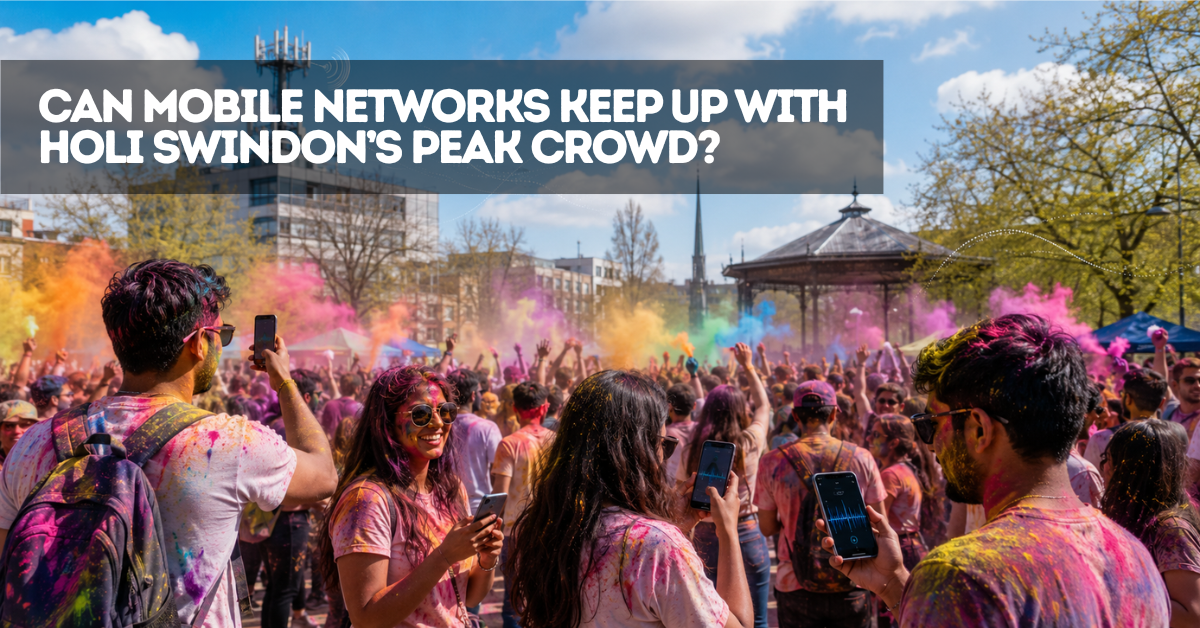
For mobile operators, events of this type create a short-term but demanding network scenario. Large numbers of users may upload photos and videos, use social applications, stream content, make calls and access mobile services at the same time. This places pressure on radio resources, uplink capacity, downlink throughput, latency and mobility between 5G and LTE.
The Holi Swindon assessment provided an opportunity to review how four mobile service providers performed under these live conditions.
Download Holi Swindon Report
DownloadContext and Relevance
Public events can create localised congestion even where normal-day network performance is stable. The challenge is not simply network coverage. Operators must maintain usable service quality while the number of active users, connected devices and simultaneous sessions increases.
During high-density events, network teams need to understand:
-
How consistently devices remain connected to 5G
-
Whether data throughput remains stable as demand rises
-
How uplink performance changes when users share media or stream live content
-
Whether latency increases under congestion
-
How efficiently networks manage movement between 5G and LTE
-
Whether voice services remain reliable during busy periods
These are practical conditions for assessing real user experience rather than only coverage availability.
Measurement Approach
The field assessment was carried out during peak event activity across four operators:
- EE
- Vodafone
- Lebara
- O2
The measurements focused on user-experienced mobile performance, including:
-
4G and 5G radio access distribution
-
Signal strength and signal quality
-
Downlink and uplink throughput
-
Latency behaviour
-
Voice service performance
-
Network transitions between 5G and LTE
All results reflect live measurements recorded during the event and should be read as an assessment of performance at this specific location, time and user-density condition.
1. 5G Availability Did Not Always Mean Sustained 5G Performance
5G coverage was available across the event location. However, device behaviour varied as user demand increased.
During periods of higher load, several devices moved from 5G back to LTE. This shows that 5G availability alone does not guarantee that devices will remain on 5G throughout the event.
The result highlights the importance of capacity planning, load distribution and mobility management. Networks need sufficient radio capacity and effective 5G-to-LTE balancing to maintain service consistency when demand rises sharply.
2. Higher User Density Affected Network Stability
As the number of active users increased, the networks showed signs of congestion. The effects included:
-
Lower and more variable throughput
-
Changes in signal-quality behaviour
-
Higher latency
-
More frequent 5G-to-LTE and LTE-to-5G transitions
These changes indicate competition for available network resources. From a user perspective, the impact may appear as slower downloads, delayed uploads, inconsistent video performance or reduced responsiveness in applications.
3. Throughput Stability Was More Important Than Peak Speed
The assessment recorded peak downlink performance of up to approximately 185 Mbps on certain networks. However, peak performance was not sustained consistently throughout the event.
Other networks recorded lower downlink results, around 58 Mbps, with greater variation during busy periods.
This distinction is important. A single high-speed measurement does not provide the full picture of user experience. For event environments, stable throughput across time and location is often more meaningful than the highest peak speed achieved during one test.
4. Uplink Performance Was a Key Constraint
Uplink performance varied significantly between the networks assessed.
Higher-performing networks achieved uplink speeds of approximately 42 Mbps. Lower-performing networks dropped below 1 Mbps during some measurements.
This matters because event users increasingly depend on uplink capacity. They upload photos and videos, send content through social applications, join video calls and share real-time information. Limited uplink capacity can affect these services even when downlink performance appears acceptable.
For operators, uplink resource allocation should remain an important part of event-capacity planning.
5. Signal Strength Alone Did Not Determine User Experience
The assessment found that stronger RSRP values did not always result in better throughput or lower latency.
Networks with moderate signal levels sometimes delivered more consistent performance than networks with stronger signal strength. This indicates that signal quality, scheduling efficiency and available radio resources can have a greater effect on service experience than signal strength alone.
For this reason, event testing should assess a combination of RF, throughput, latency and service-quality KPIs rather than relying only on coverage measurements.
6. Voice Services Remained Stable
Voice-service performance was more resilient than data performance during the event.
Call success rates were close to 100%, and call setup times remained within acceptable levels across the networks assessed. This suggests that voice services, including VoLTE and circuit-switched fallback where applicable, remained stable despite higher data demand.
Operator-Level Summary
-
EE: More consistent throughput and stable performance during congestion.
-
Vodafone: Good radio conditions with moderate performance variation.
-
Lebara: Average performance across the measured parameters.
-
O2: Lower throughput consistency during high-load periods.
These findings are specific to Holi Swindon 2026 and should not be treated as a general national comparison of operator performance.
Implications for Network Planning
High-density events show why mobile performance must be assessed under real demand conditions. Coverage alone does not show whether a network can support large numbers of simultaneous users.
The assessment highlights several areas for operators to consider:
-
Capacity planning for short-term traffic spikes
-
Uplink resource allocation for media-heavy usage
-
5G and LTE load-balancing strategy
-
Real-time monitoring during major events
-
Throughput consistency rather than only peak-speed results
-
Service-quality testing across voice, data and video applications
Conclusion:
Holi Swindon 2026 provided a practical example of mobile network performance under concentrated demand.
The assessment showed that network behaviour can change quickly when large numbers of users connect within a confined area. Throughput stability, uplink capacity, latency and 5G-to-LTE mobility all influenced the user experience.
As mobile usage continues to include more video, media uploads and real-time applications, event-based testing will remain useful for operators that want to understand network performance beyond standard coverage checks.
About RantCell
RantCell is a smartphone-based RF Drive Test Software platform for mobile operators, regulators, system integrators, enterprises and private network teams. The platform supports 4G, 5G, CBRS, Wi-Fi, indoor walk testing, drive testing, benchmarking, crowdsourcing, automated reporting and large-scale network-performance analytics.